Case 3 — Public Reserve Verification
Scenario
Carol holds HKD 1,000 in hkd.hsbc on Hkchain. She wants to verify that her balance is genuinely backed by reserves at HSBC, without relying on a press release or an auditor's website.
This case demonstrates public verifiability of reserve backing — a direct mechanism for meeting HKMA's "public disclosure" requirement and, more importantly, for building end-user trust in licensed stablecoins.
Actors
| Actor | Role |
|---|---|
| Carol | Retail L3 holder |
| HSBC | Licensed issuer of hkd.hsbc |
| Auditor A | Registered auditor for HSBC attestations |
| Any member of the public | Can do this same verification for any address |
Preconditions
- Carol has been KYC'd by HSBC (L3) and holds HKD 1,000
- HSBC has submitted a monthly attestation covering 2026-03 (period end 2026-03-31), with random-day snapshot on 2026-03-17
- Auditor A has co-signed that attestation (
AttestationFinalized) - HSBC's off-chain PDF attestation report is published at
https://hsbc.com/.../attestations/2026-03.pdf; its SHA-256 hash is recorded on chain
Flow
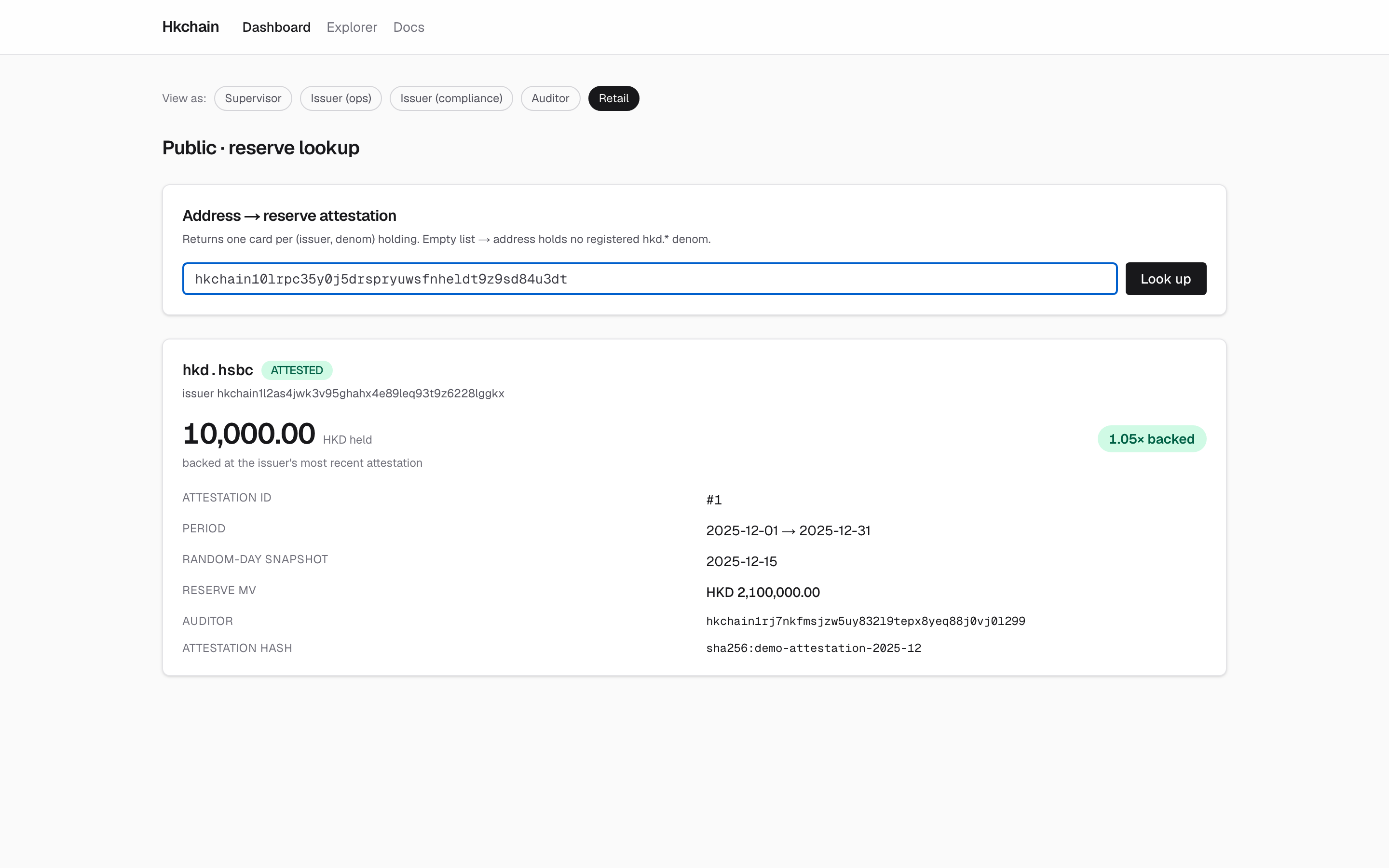
Step 1 — Carol opens the Public Reserve Lookup page
https://hkchain.example/public/reserve-lookup
She enters her address (or it's auto-filled if her wallet is connected).
Step 2 — Lookup executes three queries
The page runs (in parallel):
QueryBalance(address=carol, denom=hkd.hsbc)— returns1000 hkd.hsbcQueryLatestAttestation(issuer=HSBC, denom=hkd.hsbc)— returns the attestation covering Carol's current holdingQueryAttestationHistory(issuer=HSBC, limit=12)— returns the last 12 attestations for context
Step 3 — Results displayed
┌──────────────────────────────────────────────────────────────┐
│ Your balance:                                   HKD 1,000    │
│ Denom:                                          hkd.hsbc     │
│ Issuer:                                         HSBC         │
│                                                              │
│ Current backing attestation                                  │
│ ────────────────────────────                                 │
│ Period:            2026-03-01 – 2026-03-31                   │
│ Random-day snap:   2026-03-17                                │
│ Circulation:       HKD 1,247,392,150                         │
│ Reserve (market):  HKD 1,310,000,000                         │
│ Coverage ratio:    105.0%                                    │
│                                                              │
│ Signatures                                                   │
│ ─────────                                                    │
│ Issuer (HSBC):     0x… (verified)                            │
│ Auditor (Auditor A): 0x… (verified, registered)              │
│ Finalized at:      2026-04-05 block 382,991                  │
│                                                              │
│ Public attestation report                                    │
│ ─────────────────────────                                    │
│ PDF hash (on-chain): 0x7f3a1b9e…                             │
│ Public URL:          https://hsbc.com/…/2026-03.pdf          │
│ [Download and verify hash]  [View attestation on Explorer]   │
└──────────────────────────────────────────────────────────────┘
Step 4 — Carol (or anyone) can independently verify the hash
Download the PDF from HSBC's site. Compute the SHA-256. Compare to the on-chain hash 0x7f3a1b9e…. Match → the PDF Carol read is the exact PDF the auditor signed. No intermediary fabrication possible.
Step 5 — Carol can drill into past attestations
The history shows 12 months. For each, she can see period, circulation, coverage, and the corresponding PDF hash. Any consecutive pair lets her check: was the circulation monotone? Did coverage ever dip below 100%? Are attestation cadences consistent?
What this case demonstrates
- Public verifiability as a primitive, not a PR mechanism. The chain exposes the query; anyone can run it. No special access.
- Cryptographic binding between on-chain state and off-chain PDF. The PDF hash on chain is the attestation's fingerprint. Tampered PDFs fail hash comparison.
- Multi-sig attestation. The attestation carries both issuer and auditor signatures, verifiable on chain.
- HKMA's "public disclosure" requirement fulfilled end-to-end: prominent location on issuer website (the PDF), publicly queryable chain record (the hash + metadata), independent auditor sign.
- Random-day snapshot — per HKMA guideline, the attestation covers both period-end and a randomly selected business day. Both values are on chain and verifiable.
Edge case — attestation missing or stale
If Carol looks up her balance and no current attestation is found (or the latest attestation is older than the freshness parameter), the page displays a prominent notice:
⚠ No current attestation for this issuer.
  Latest attestation: 2026-02-28 (57 days ago)
  Issuer cannot mint additional HKD until a new attestation is finalized.
Carol can see exactly what is going on and contact HSBC (or the regulator) if needed. The chain does not hide the state.
Audience-specific value
- For retail holders: direct trust primitive — "is my money real?" gets a clear, cryptographic answer
- For institutional holders: due-diligence automation — treasury systems can programmatically verify reserve state before holding
- For HKMA: demonstration of a chain's capacity to meet the "public disclosure" standard in a way that goes beyond website links
- For auditors: their signatures become first-class chain citizens; reputation accrues
- For journalists / civil society: the chain is the primary source, not an issuer's blog
Implementation notes (for engineering readers)
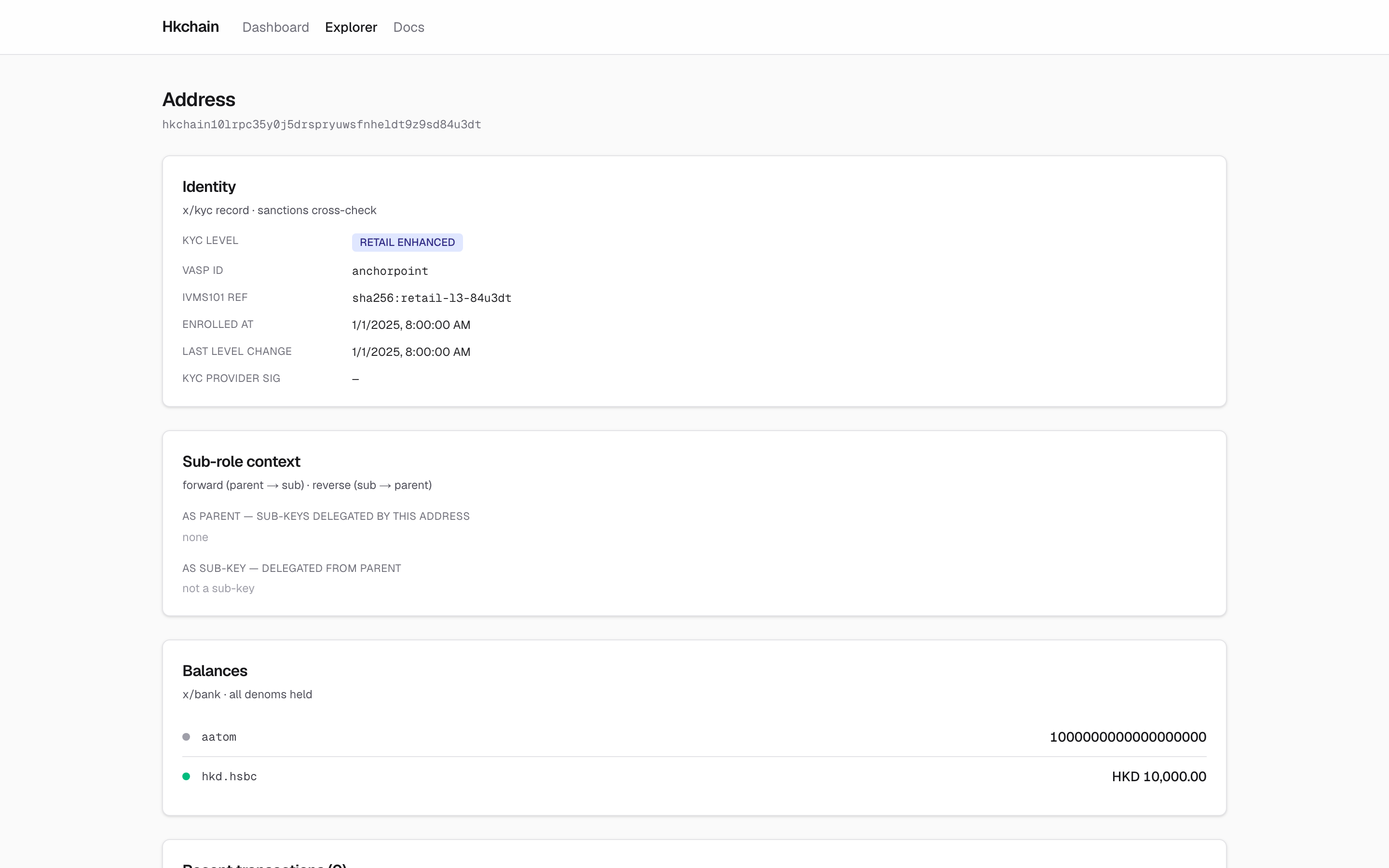
QueryReserveForAddress(address)returns oneAddressReserveBinding{issuer, denom, balance, attestation}per registered denom the address currently holds. An empty list means the address holds no stablecoin-module denom. Public-facing UX is where the effort is.- Historical attestations per issuer are queryable efficiently via
QueryAttestations{issuer, pagination}, which walks the per-issuer attestation-id index. - PDF hash verification is manual today (user downloads and computes). A browser extension that auto-verifies would be a natural future addition.
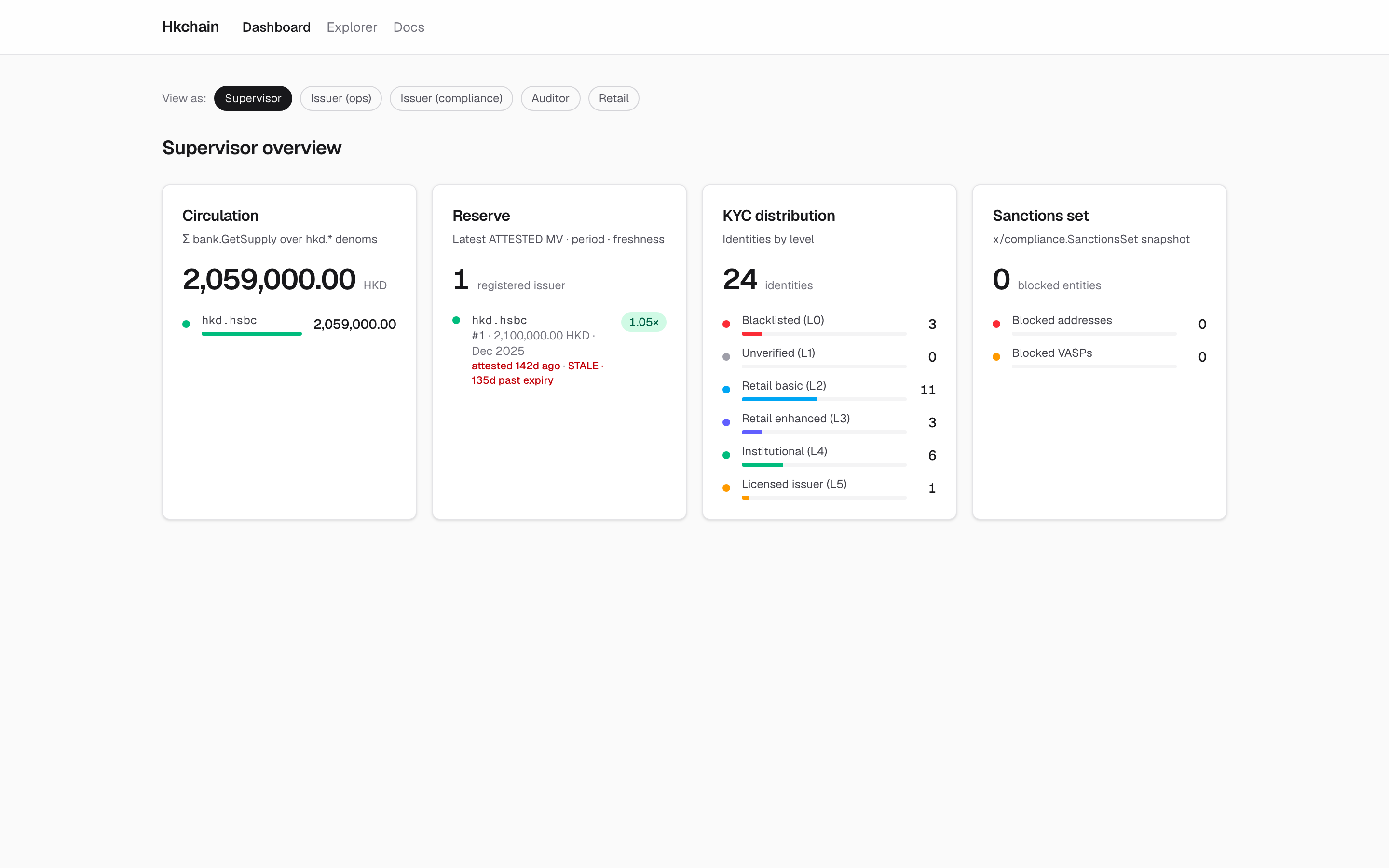
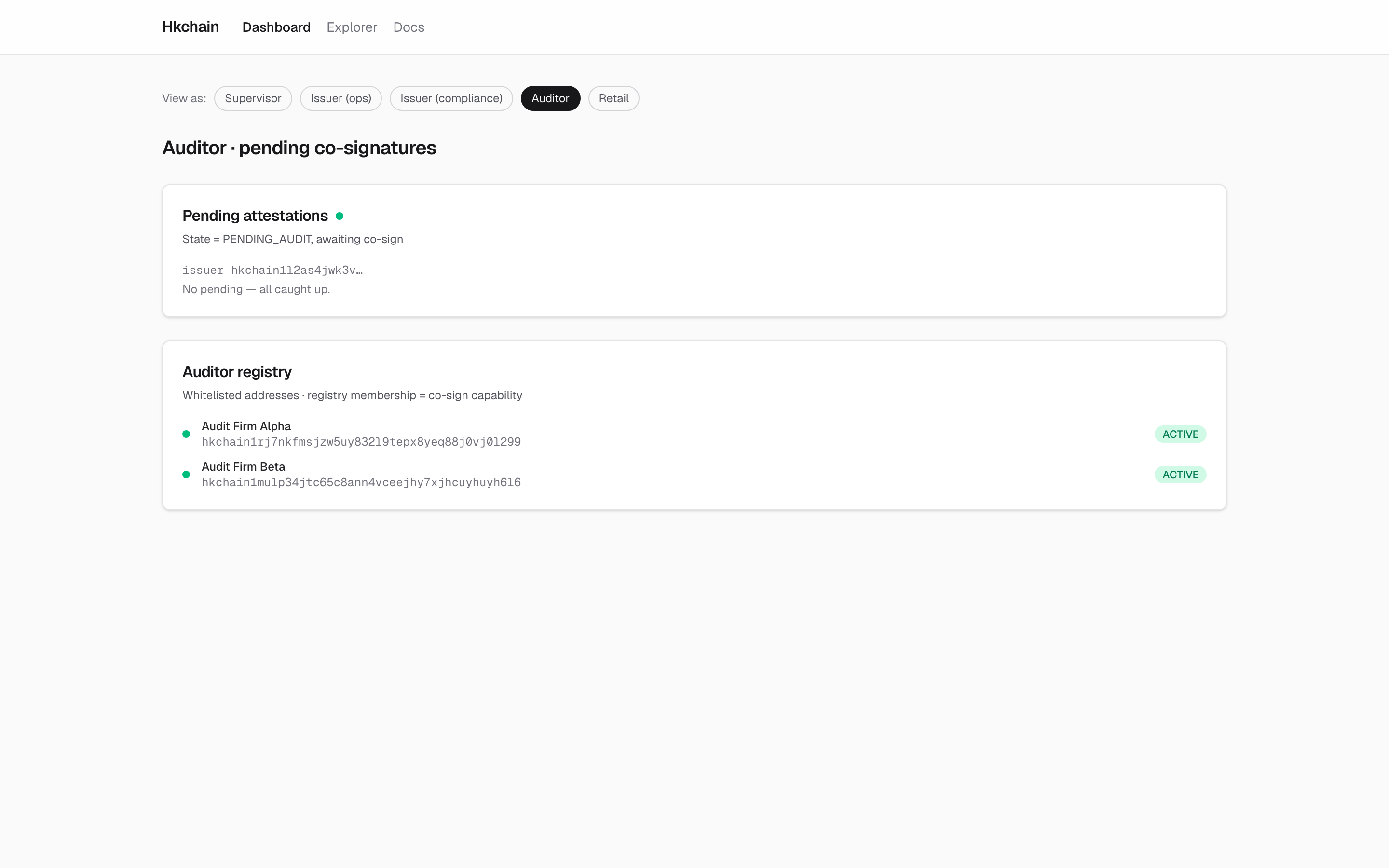
Counterpart surfaces — supervisor and auditor
The public-lookup surface is one of three views over the same chain state. The supervisor and auditor consume the same data through role-tailored dashboards: