Case 1 — Cross-Issuer B2B Settlement
Scenario
Alice Corp (HK company, KYC level 4 institutional, VASP identifier: HSBC) pays Bob Ltd (HK company, level 4, VASP identifier: Anchorpoint) for an outstanding invoice. This case walks the compliance flow across three transfer amounts to show the full spectrum of Hkchain's compliance behavior:
- Variant A: HKD 500 — small, auto-passes with minimal Travel Rule
- Variant B: HKD 50,000 — medium, triggers threshold flag, reviewer approves
- Variant C: HKD 5,000,000 — large, triggers threshold + velocity flags, reviewer escalates to officer
All three use the same underlying machinery; only amount and resulting flag path differ.
Actors
| Actor | Role | Identity on Hkchain |
|---|---|---|
| Alice Corp | Paying institutional client | L4, VASP=HSBC, address hkchain1alice… |
| Bob Ltd | Receiving institutional client | L4, VASP=Anchorpoint, address hkchain1bob… |
| HSBC | Licensed issuer of hkd.hsbc | L5 issuer, primary key |
| HSBC Compliance Reviewer | Sub-role bound to HSBC | hkchain1hsbcrev…, role=reviewer |
| HSBC Compliance Officer | Sub-role bound to HSBC | hkchain1hsbcofc…, role=officer |
| Anchorpoint | Licensed issuer of hkd.ap (relevant for receiving-side review) | L5 issuer |
| Auditor A | Registered auditor | hkchain1aud… |
| HKMA | Supervisor | Dashboard only, no on-chain identity |
For this case, Alice holds hkd.hsbc (previously minted by HSBC against HSBC's reserves). Bob accepts hkd.hsbc (he may later redeem with HSBC or keep). No cross-denom conversion is required in this case — that would be a separate case (future docs).
Preconditions
- Alice is at L4 with an off-chain IVMS101 payload held by HSBC (PII hash on chain)
- Bob is at L4 with off-chain IVMS101 held by Anchorpoint
- Neither party is on the sanctions set
- HSBC has an
ATTESTEDreserve covering current circulation - Alice holds HKD 10,000,000 in
hkd.hsbc(more than enough for any variant)
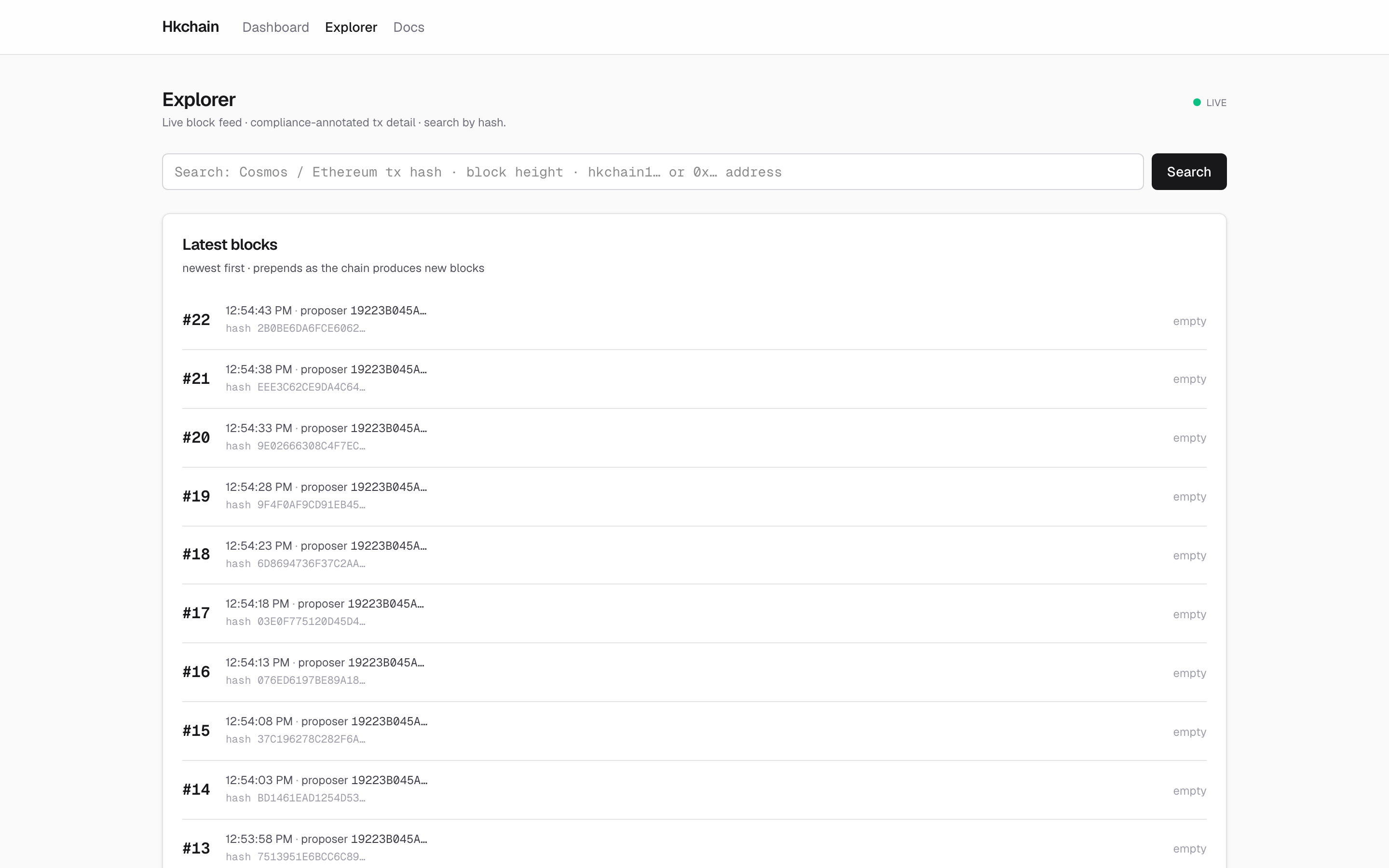
Variant A — HKD 500 (auto-pass, minimal Travel Rule)
Step 1 — Alice's treasury system constructs the transaction
MsgSend {
  from: hkchain1alice..., to: hkchain1bob..., denom: hkd.hsbc, amount: 50000  // minor units
}
tx extension: TravelRulePayload {
  originator: { vasp: HSBC, entity_ref: ALICE-001 },
  beneficiary: { vasp: Anchorpoint, entity_ref: BOB-A-017 }
}
Note: the extension only needs minimal IVMS101 fields because the amount is below the HKD 8,000 enhanced-fields threshold.
Step 2 — AnteHandler decorators run
| Decorator | Result | Reason |
|---|---|---|
| KycGate | pass | Alice L4 ✓, Bob L4 ✓, no blacklist |
| Sanctions | pass | No address or VASP hits |
| TravelRule | pass | Minimal payload present; amount below enhanced threshold |
| Threshold | pass | Amount below suspicious threshold |
| Velocity | pass | Alice's recent velocity normal |
| RoleGate | pass | Signed by Alice's primary key; not a sub-role message |
Step 3 — Transfer executes
x/bank moves 500 HKD from Alice to Bob. x/compliance.AppendAudit(TransferEvent{…, travel_rule_hash: 0x…, flags: []}).
Step 4 — What each role sees
- Alice: tx succeeded; balance updated.
- Bob: balance updated.
- HSBC Compliance Reviewer: nothing in queue (no flag raised).
- HSBC Compliance Officer: nothing in queue.
- Anchorpoint Compliance: tx visible in their incoming audit log, no flag; routine CPF review per their internal policy.
- HKMA Supervisor: tx appears in their live event feed as a benign transfer, contributing to the daily circulation statement.
Elapsed time: one block. No human intervention required.
Variant B — HKD 50,000 (threshold flag, reviewer approves)
Step 1 — Transaction constructed with full IVMS101
Because 50,000 ≥ HKD 8,000, the TravelRulePayload must include the enhanced field set:
TravelRulePayload {
  originator: {
    name: "Alice Corp",
    address_hash: 0xabc…,  // physical address, hashed
    date_of_incorporation_hash: 0xdef…,
    vasp: HSBC, entity_ref: ALICE-001
  },
  beneficiary: {
    name: "Bob Ltd",
    address_hash: 0x123…,
    vasp: Anchorpoint, entity_ref: BOB-A-017
  },
  purpose: "invoice INV-2026-0418"
}
The full payload lives off chain with HSBC (originator's VASP); only the hash is on chain.
Step 2 — AnteHandler
| Decorator | Result | Reason |
|---|---|---|
| KycGate | pass | both L4 |
| Sanctions | pass | no hits |
| TravelRule | pass | enhanced payload present; all required fields |
| Threshold | flag emitted | amount ≥ HKD 8,000 (Rules.travel_rule_full_threshold reused as the suspicious-amount cutoff in MVP) |
| Velocity | pass | normal velocity |
| RoleGate | pass | Alice's primary key |
FlagEmitted event: {flag_id: F-2026-04-19-001, tx_hash, reasons: [threshold(50000)], state: EMITTED}.
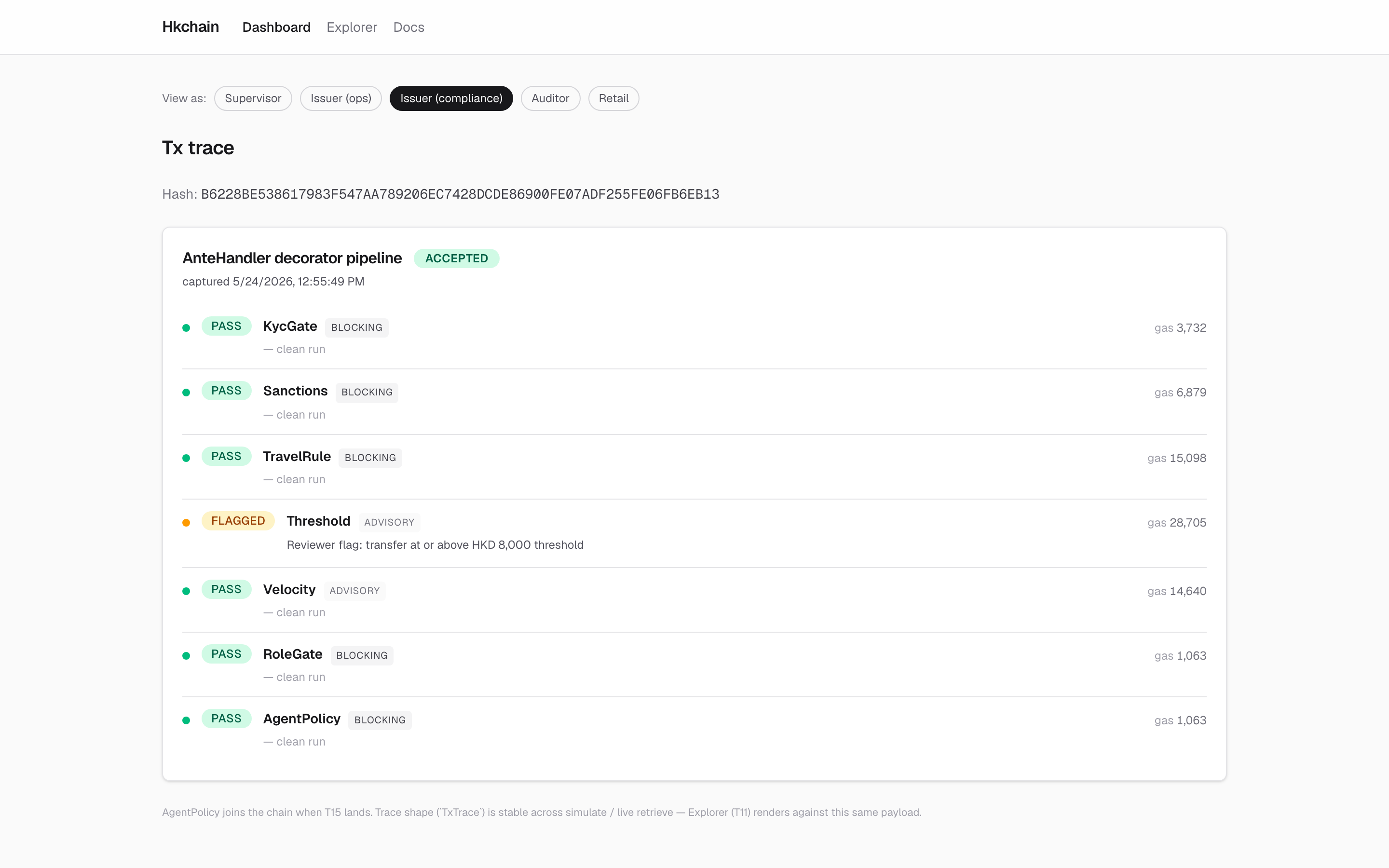
Step 3 — Transfer still executes
Threshold is advisory in MVP: the transfer completes. Only a flag is raised for later review.
Step 4 — Reviewer picks up the flag
In the HSBC Compliance Console (/compliance/review-queue?issuer=HSBC), the reviewer sees a new flag for F-2026-04-19-001. They click in:
- Transfer details: amount, denom, parties, block height, Travel Rule payload hash
- Historical context: Alice's recent transaction pattern (auto-rendered from audit log)
- Reviewer's off-chain case system opens (via deep link) for invoice INV-2026-0418 verification
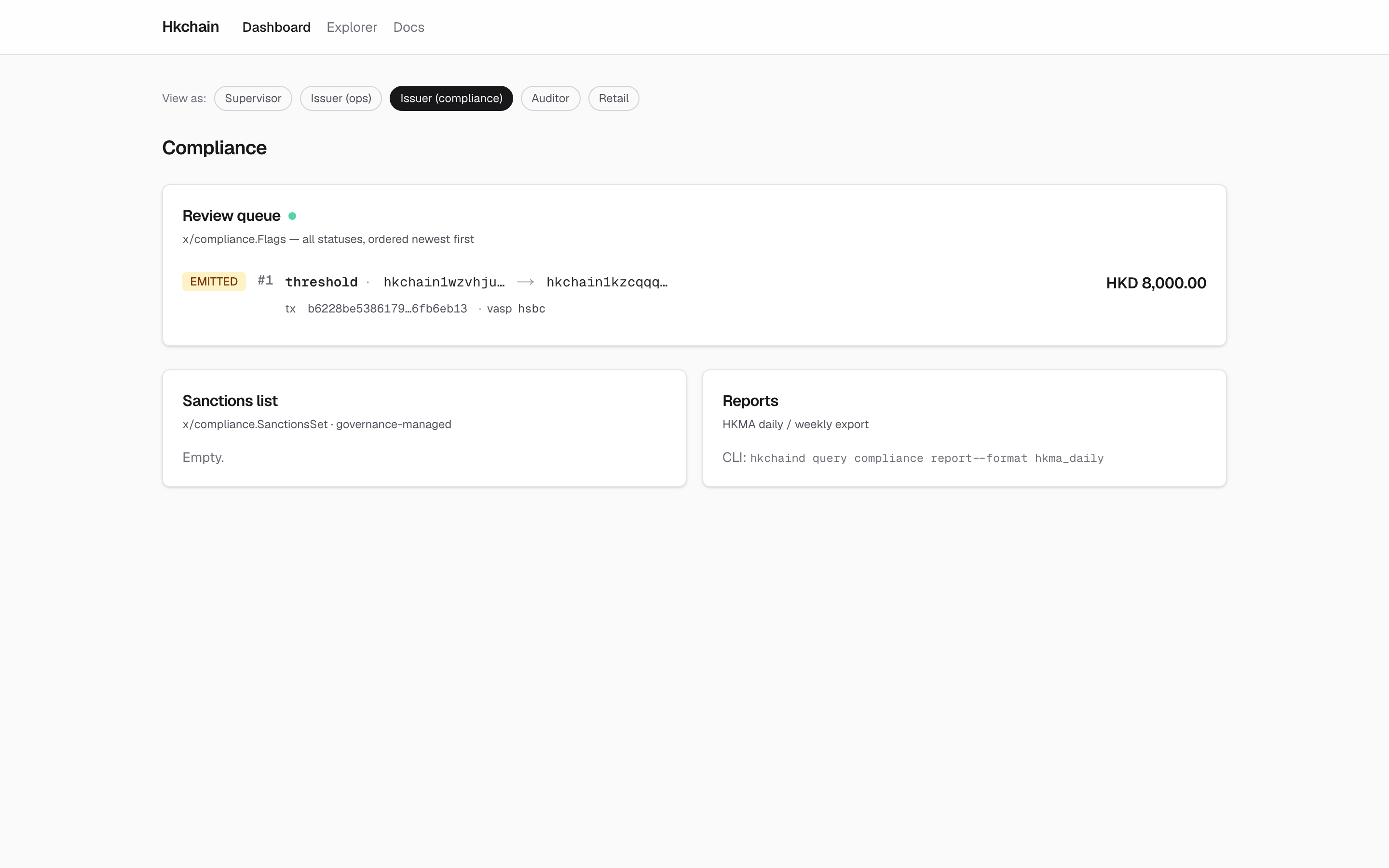
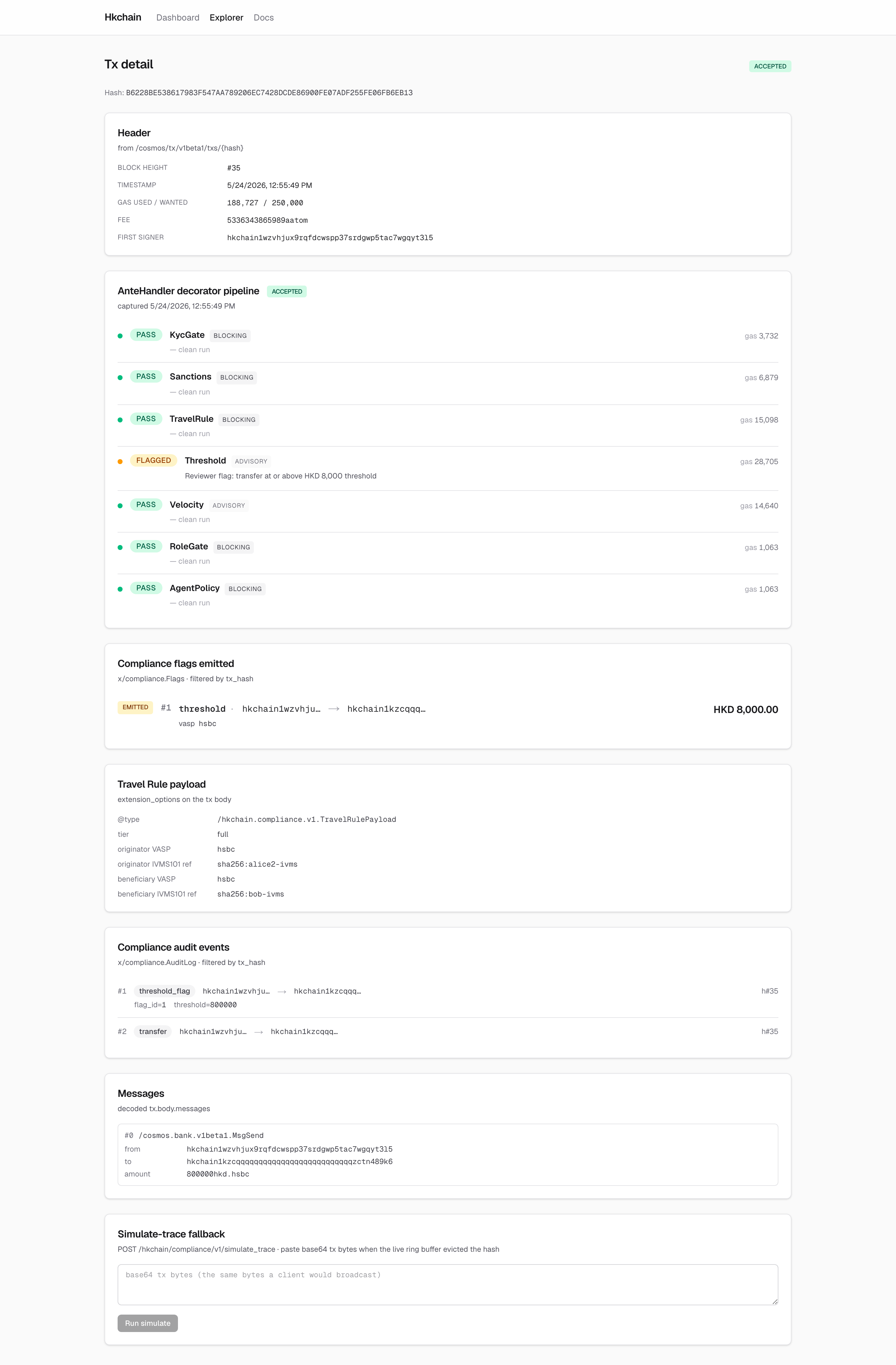
The reviewer pulls HSBC's internal KYC file and the invoice PDF, confirms the payment is consistent with Alice's normal business pattern, and clicks Approve.
MsgReviewFlag {
  flag_id: F-2026-04-19-001,
  decision: APPROVED,
  evidence_hash: 0xe1e1e1…   // hash of reviewer's memo in HSBC's case management system
}
Signed by the reviewer sub-key (hkchain1hsbcrev…). The RoleGateDecorator verifies the signer is bound as a reviewer under HSBC; message type is in the allowlist. Accepted.
x/compliance transitions flag state to RESOLVED_APPROVED. Emits FlagResolved event.
Step 5 — What each role sees now
- HSBC Compliance Reviewer: flag moved from "open" queue to "recently resolved"
- HSBC Compliance Officer: no action needed (not escalated)
- Anchorpoint Compliance: sees incoming transfer in their audit log with Bob as recipient; optionally runs their own review (independent of HSBC)
- HKMA Supervisor: flag appears in event feed with its full lifecycle —
FlagEmitted→FlagResolved{APPROVED}, linked to the transfer and the reviewer's evidence hash - Alice and Bob: neither sees any interruption; tx executed normally
Elapsed time: one block for tx; typically minutes to hours for human review (SLA per issuer policy).
Variant C — HKD 5,000,000 (flag + escalation to officer)
Step 1 — Transaction constructed (enhanced Travel Rule as before)
Step 2 — AnteHandler
| Decorator | Result | Reason |
|---|---|---|
| KycGate | pass | both L4 |
| Sanctions | pass | no hits |
| TravelRule | pass | enhanced payload present |
| Threshold | flag | amount well above threshold |
| Velocity | flag | Alice's recent volume suggests structuring risk (hypothetical burst) |
| RoleGate | pass |
FlagEmitted: {flag_id: F-2026-04-19-002, reasons: [threshold(5000000), velocity(4tx/1h)], state: EMITTED}.
Step 3 — Transfer still executes
Both decorators are advisory. The flag is emitted with two reasons; transfer completes.
Step 4 — Reviewer escalates
HSBC's reviewer opens the flag. The combination of amount and velocity triggers their internal policy to escalate. They sign:
MsgReviewFlag {
  flag_id: F-2026-04-19-002,
  decision: ESCALATED,
  evidence_hash: 0xf0f0f0…   // reviewer's initial investigation notes
}
Flag state transitions: EMITTED → PENDING_OFFICER. Reviewer's queue no longer shows this flag; the Officer's queue does.
Step 5 — Officer reviews
HSBC's compliance officer (hkchain1hsbcofc…, role=officer) opens the escalated flag. They pull additional context:
- Alice's full KYC profile
- Pattern of recent large transfers
- Any adverse-media signals (off-chain screening)
- Communication with the client's treasury desk to verify the transfer
In this scenario the officer verifies the transfer is a legitimate scheduled acquisition payment, documented in HSBC's records. They sign:
MsgCloseFlag {
  flag_id: F-2026-04-19-002,
  officer_sig,
  decision: APPROVED,
  evidence_hash: 0x9a9a9a…   // officer's close memo
}
The RoleGateDecorator verifies the officer sub-role. Accepted. Flag state → RESOLVED_APPROVED. Emits FlagResolved.
Alternative sub-path — officer blocks
Had the officer found the transfer inconsistent with Alice's normal activity or indicative of suspicious behavior, they could have signed:
MsgCloseFlag {
  flag_id: F-2026-04-19-002,
  officer_sig,
  decision: BLOCKED,
  evidence_hash: 0x8b8b8b…
}
This records the flag as RESOLVED_BLOCKED and may be followed by MsgBlacklist(alice_address) if internal determination supports it. The transfer already executed (advisory flags don't block inclusion), so actual remediation — clawback, account freeze, SAR filing — happens as separate on-chain + off-chain actions.
For future (outside MVP scope), Hkchain could offer optional "hold until reviewed" semantics for certain high-risk rules, but this is an anti-pattern for general use because it creates UX unpredictability.
Step 6 — What each role sees
- HSBC Reviewer: flag moved from their queue after escalation
- HSBC Officer: flag in their queue, then moved to "recently resolved"
- HKMA Supervisor: full lifecycle visible —
FlagEmitted(with two reasons) →FlagEscalated→FlagResolved{APPROVED|BLOCKED}, all linked and queryable - Alice, Bob: no visible interruption (tx executed); if Alice were later blocked by MsgBlacklist, subsequent transfers would fail at AnteHandler
What this case demonstrates
- Chain-level Travel Rule enforcement (zero-threshold for every tx; enhanced at ≥ HKD 8,000)
- Auto-decided cases where no flag is raised — the common case, no human friction
- Flag-and-review for larger transfers, with full audit trail of the reviewer's decision and evidence hash
- Escalation path for the most consequential decisions, requiring a second signatory in a higher role
- Role separation — reviewer and officer are distinct sub-keys with distinct allowlists, enforced by the AnteHandler
- Supervisor observability — HKMA sees the full lifecycle of each flag without needing to ask the issuer for data
- Interoperability — the same compliance model serves both issuers involved; Anchorpoint (recipient side) has symmetric observability over their own customer
Forward-looking notes (not in MVP)
- The reviewer role is a natural candidate for AI-assisted triage: the AI recommends an action (approve / escalate) and drafts the evidence memo; the human reviewer confirms. See
future/ai-agent-compliance-review.mdfor the longer-term vision. MVP keeps humans in both loops. - True cross-denom B2B settlement (Alice holds
hkd.hsbc, Bob accepts onlyhkd.ap) requires either a neutral intermediary or an on-chain redemption-and-reissuance flow. Out of MVP scope; the single-denom path is sufficient to demonstrate the compliance story.